
Can Fascia Bowen Help Children with Dyspraxia/Developmental Coordination Disorder?
24 February 2026

Melanie Morgan-Jones is a Doctoral Research Scientist in Health, Bowen practitioner, Homeopath and a former law firm Head of Investment, and Fascia Bowen is a therapeutic intervention taught exclusively by the College of Bowen Studies. Melanie conducted the research with ethical approval from the University of Bath and was granted her doctorate on April 21st 2015.
Background
Developmental coordination disorder (DCD), also known as 'dyspraxia', is a disorder emerging in childhood characterised by motor skill impairments. The motor difficulties often produce negative effects in other areas of life, such as poor self-esteem and reduced social interactions. One treatment used for DCD is fascia Bowen therapy, which involves stimulating the fascia tissues of the body using gentle movements over the skin to improve overall muscle movement. However, no other studies to date have been reported testing the effectiveness of Fascia Bowen in DCD.
Methods
The pilot study tested the effectiveness of 6 weeks of Fascia Bowen in 10 boys aged 8–11 years with DCD. None of the boys had ever received treatment in any form before this study. Motor skills were assessed using the Movement Assessment Battery for Children-2 (MABC-2) and the DCD questionnaire, and psycho-social functioning was measured using the Self-Perception Profile, Spence Social Skills Questionnaire, and Strengths and Difficulties Questionnaire. All measures of interest were assessed before and after the therapy.
Results
Results showed significant improvement in motor function post-intervention, on the MABC-2. However, no significant improvements were seen in psycho-social measures, at least within the short time-frame of the therapy in the current study. They show that the overall neuromuscular function demonstrated a significant improvement from pre to post intervention. Looking individually at the total percentile score for each child, the table demonstrates how many children moved between categories on their movement difficulties. It was found that 60% of the children were no longer clinically being classified as having a movement difficulty, and only three children remained in the red category, but improved nevertheless (the child with the least improvement failed to stay on the treatment couch for the majority of their sessions).
Conclusions
The current pilot study revealed improvements in motor functioning after Fascia Bowen therapy, across both performance and questionnaire measures, but that these improvements did not extend to wider areas of life. Further research in DCD is needed to test the effectiveness of Fascia Bowen in larger studies with expanded ages and both genders over longer periods, including the generalisation of results of these longer interventions to different areas of life beyond motor ability.
Movement Assessment Battery for Children (MABC-2)
This is an internationally acknowledged measurement tool which uses a traffic light system of categories denoting severity of movement difficulties. Red represents 5th centile and below and indicates significant movement difficulty; amber is between the 5th and 15th centile suggesting the child is at risk of having a movement difficulty; and green means above the 15th centile, and indicates no detected movement difficulty.
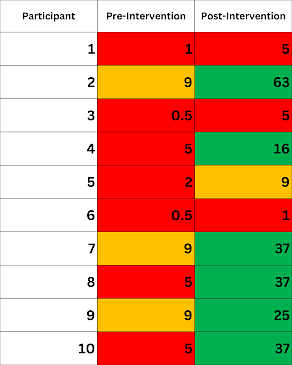
Thesis Table 2: Pre and Post Intervention for Each Participant in the MAC-2
HENDERSON, S. E., SUGDEN, D. A. & BARNETT, A. L. 2007. Movement assessment battery for children-2: Movement ABC-2 : Examiner's manual, Pearson.
Fascia Bowen Training is available to all qualified manual Therapists. It can be combined with regular Bowen Therapy or used in a therapy in its own right, as demonstrated within this article. If you are interested in learning Fascia Bowen, please contact jo@collegeofbowenstudies.co.uk or visit our CPD Page for training dates.


